Latin America Leads the World: 7.7% of GDP in Stablecoin Flows
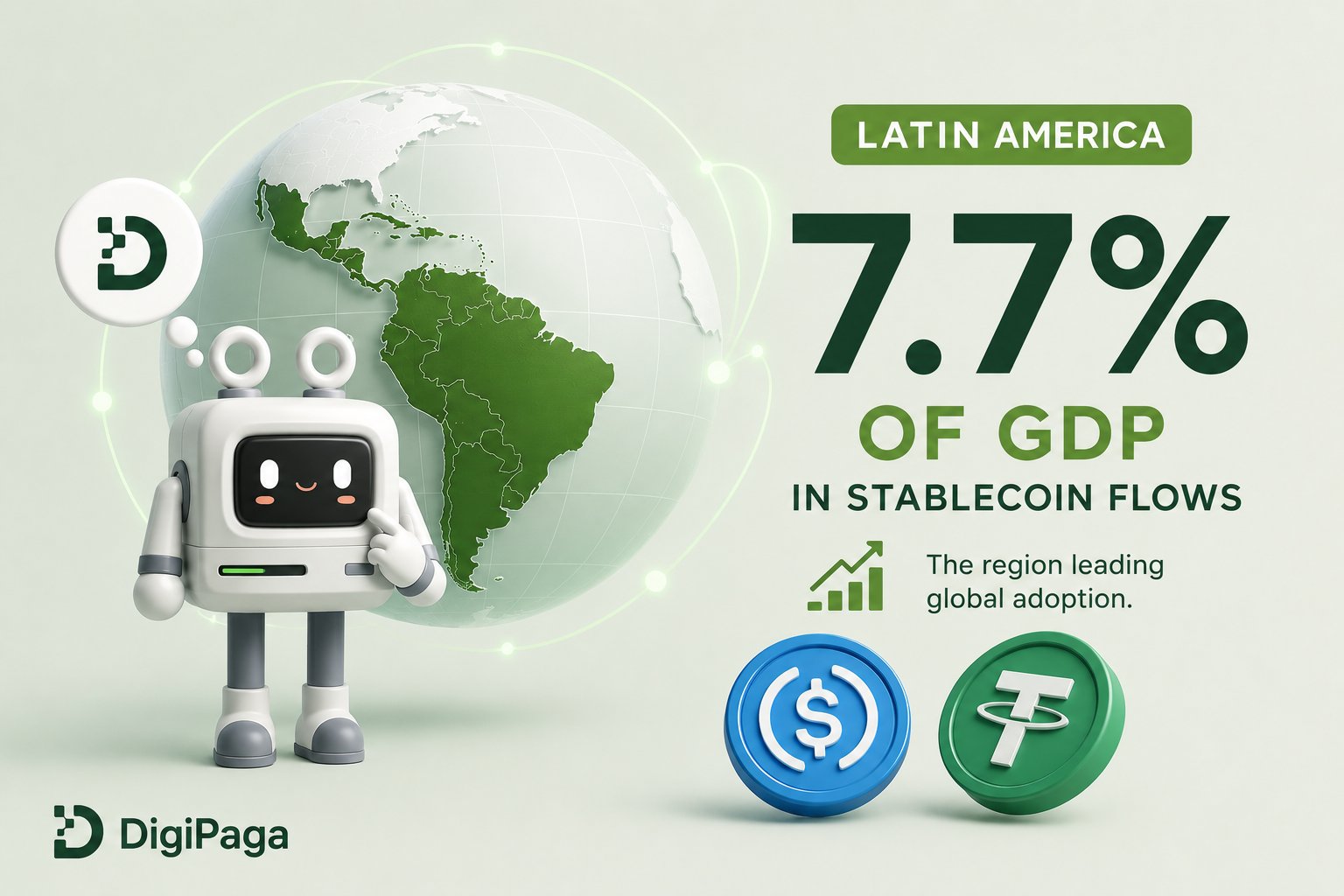
A groundbreaking 2025 report from the International Monetary Fund (IMF) reveals what many in Latin America already knew: the region is leading the world in stablecoin adoption. According to the IMF's comprehensive analysis of $2 trillion in stablecoin transactions, Latin America and the Caribbean commands 7.7% of its GDP in stablecoin flows — the highest percentage of any region globally [3].
The Numbers Tell a Story
The IMF's Working Paper, "Decrypting Crypto: How to Estimate International Stablecoin Flows," used advanced AI and machine learning to track geographic stablecoin movements throughout 2024 [3]. The findings are remarkable:
By the Numbers:
- Latin America & Caribbean: 7.7% of GDP in stablecoin flows
- Africa & Middle East: 6.7% of GDP
- North America, Europe, Asia-Pacific: 0.4% of GDP each
While Asia-Pacific leads in absolute dollar terms ($407 billion in inflows) and North America follows ($363 billion), Latin America's economic significance is unmatched when measured relative to economic output [2].
Why Latin America?
The IMF report reveals a critical insight: only 12% of stablecoin flows in Latin America are intraregional — meaning 88% are international transactions [2]. This pattern points to the primary use cases:
- Remittances: Workers sending money home to families
- Cross-border commerce: Businesses paying international suppliers
- Inflation hedging: Protecting savings from local currency devaluation
- International trade: Freelancers and exporters receiving global payments
This isn't adoption for speculation — it's adoption for survival and economic participation.
The Real-World Impact
For context, Latin America processed an estimated $66.39 billion in stablecoin flows in 2024 [2]. But these aren't just numbers — they represent:
- Mexican families receiving remittances from the United States in minutes instead of days
- Argentine businesses protecting working capital from 100%+ annual inflation
- Brazilian freelancers getting paid by US clients without 5% wire fees
- Colombian exporters settling international invoices instantly
What the IMF Methodology Reveals
The IMF's research is particularly significant because it overcomes the traditional challenge of tracking cryptocurrency flows: geographic anonymity. By combining AI-powered blockchain analysis with machine learning classification, the IMF created the first comprehensive map of international stablecoin movements [3].
Key findings include:
Transaction Patterns:
- # Stablecoins are predominantly used for international payments, not domestic transactions
- Cross-border use cases dominate in emerging markets
- Traditional remittance corridors (US-Mexico, US-Central America, Europe-South America) show the highest activity
Regional Comparison:
- North America: 34% intraregional flows (mostly domestic use)
- Latin America: Only 12% intraregional flows (88% international)
- This confirms stablecoins serve as a global payment rail for the region [2]
The Bigger Picture: $2 Trillion Global Market
The IMF analyzed $2 trillion in total stablecoin transactions for 2024, documenting massive regional variation [3]:
Global Stablecoin Flows by Region:
- Asia-Pacific: $407B inflows, $395B outflows
- North America: $363B inflows, $417B outflows
- Latin America: $66.39B total flows
- Europe: Smaller relative to GDP
- Africa & Middle East: 6.7% of GDP (second highest after LATAM)
Net Flow Dynamics:
The report found that North America shows net outflows of stablecoins, suggesting these flows meet global dollar demand — particularly in regions like Latin America where access to USD is limited [3].
Why This Matters for Financial Inclusion
The 7.7% GDP figure isn't just impressive — it's transformative. Consider:
Traditional Banking vs. Stablecoins in Latin America:
Traditional System:
- 30% of adults unbanked
- Remittance fees: 3-5%
- Settlement time: 3-7 days
- Cross-border payments: Complex, expensive
Stablecoin System:
- Only need internet access
- Transaction fees: Under 1%
- Settlement time: Minutes
- Cross-border payments: Simple, cheap
This explains why Latin Americans are embracing stablecoins at 19x the rate of developed economies (7.7% vs 0.4% of GDP).
The Use Cases Driving Adoption
The IMF's finding that 88% of flows are international reveals the real drivers:
1. Remittances
Latin America receives over $140 billion annually in remittances. Stablecoins are capturing an increasing share because they're:
- 80-90% cheaper than Western Union or MoneyGram
- 95% faster (minutes vs. days)
- Available 24/7/365
2. Inflation Protection
Countries like Argentina (100%+ inflation), Venezuela, and others use stablecoins to:
- Preserve purchasing power
- Access USD-denominated assets
- Avoid currency devaluation
3. Cross-Border Commerce
SMEs and freelancers use stablecoins to:
- Pay international suppliers instantly
- Receive payments from global clients
- Avoid 3-5% FX markups
4. International Trade
Importers and exporters leverage stablecoins for:
- Faster settlement
- Lower costs
- Transparent pricing
What This Means for the Future
The IMF report validates what's happening on the ground: Latin America isn't just adopting crypto — it's leading a fundamental reimagining of international payments [3].
Key Implications:
- Regulatory Clarity Needed: Governments must create frameworks that protect consumers while enabling innovation
- Infrastructure Investment: Payment platforms must build for this demand
- Financial Inclusion: Stablecoins are reaching the 30% of unbanked adults
- Economic Sovereignty: Citizens gain access to global financial system
The DigiPaga Perspective
At DigiPaga, we've been building for this reality from day one. The IMF's findings confirm what we see daily: Latin America needs payment infrastructure designed for the digital age — not the 1970s SWIFT system.
Our platform directly addresses the needs revealed in the IMF report:
For Remittances:
- Send & Receive: Instant stablecoin transfers with fees under 1%
- Multi-Currency Wallet: Hold USD stablecoins and convert to local currency instantly
- P2P Convert: Cash-in/cash-out network for unbanked recipients
For Cross-Border Commerce:
- Smart Swaps: AI-optimized routing for cheapest, fastest transfers
- Business Settlement: Pay suppliers, receive payments same-day
- Invoice & Payroll: Automate international payments
For Financial Inclusion:
- DigiPaga Card: Spend stablecoins at 50,000+ merchant locations
- QR Paycode: Accept payments anywhere, works offline
- No Bank Account Required: Only need smartphone and internet
Building for the 7.7%
The IMF's 7.7% GDP figure represents real people solving real problems:
- Maria in Mexico City receiving $300 monthly from her son in Texas — saves $15/month in fees vs. Western Union
- Carlos in Buenos Aires paying Chinese suppliers in USDC — settles in minutes, not 2 weeks
- Ana in São Paulo freelancing for US clients — receives payment same-day, not end-of-month
- Roberto in Bogotá protecting savings from peso devaluation — holds USDC instead of cash
These aren't edge cases. They're the mainstream reality that the IMF has now documented.
The Road Ahead
The IMF report is a call to action:
For Policymakers:
- Create clear regulatory frameworks
- Enable innovation while protecting consumers
- Recognize stablecoins as essential infrastructure
For Financial Institutions:
- Build products for the digital economy
- Reduce fees and increase speed
- Serve the unbanked population
For Technology Providers:
- Design for mobile-first users
- Prioritize accessibility and simplicity
- Enable seamless fiat-to-crypto on-ramps
Conclusion: Latin America Is Leading
The IMF's findings are clear: Latin America and the Caribbean leads the world in stablecoin adoption relative to GDP at 7.7% [3]. This isn't a trend — it's a fundamental shift in how the region moves money.
The drivers are clear:
- High remittance flows
- Currency instability
- Expensive traditional banking
- Large unbanked population
- Tech-savvy population
The solution is clear:
- Stablecoins for speed, cost, accessibility
- Infrastructure like DigiPaga to bridge crypto and fiat
- Regulatory frameworks that enable innovation
The future of money isn't coming — it's already here. And Latin America is leading the way.
Sources
- IMF Working Paper: "Decrypting Crypto: How to Estimate International Stablecoin Flows" (July 2025)
- IMF Analysis of 2024 stablecoin transactions totaling $2 trillion
- Regional stablecoin flow data: Latin America & Caribbean 7.7% of GDP
About DigiPaga
DigiPaga is building the payment engine for the Global South, with a focus on Latin America's unique needs. Our platform enables instant, low-cost stablecoin payments, remittances, and cross-border commerce — designed for the 30 million Latin Americans excluded from traditional banking.
Speed. Cost-efficiency. Accessibility. That's the DigiPaga promise.
Ready to simplify your payments?
Join thousands of businesses across Latin America using DigiPaga to scale their operations.